
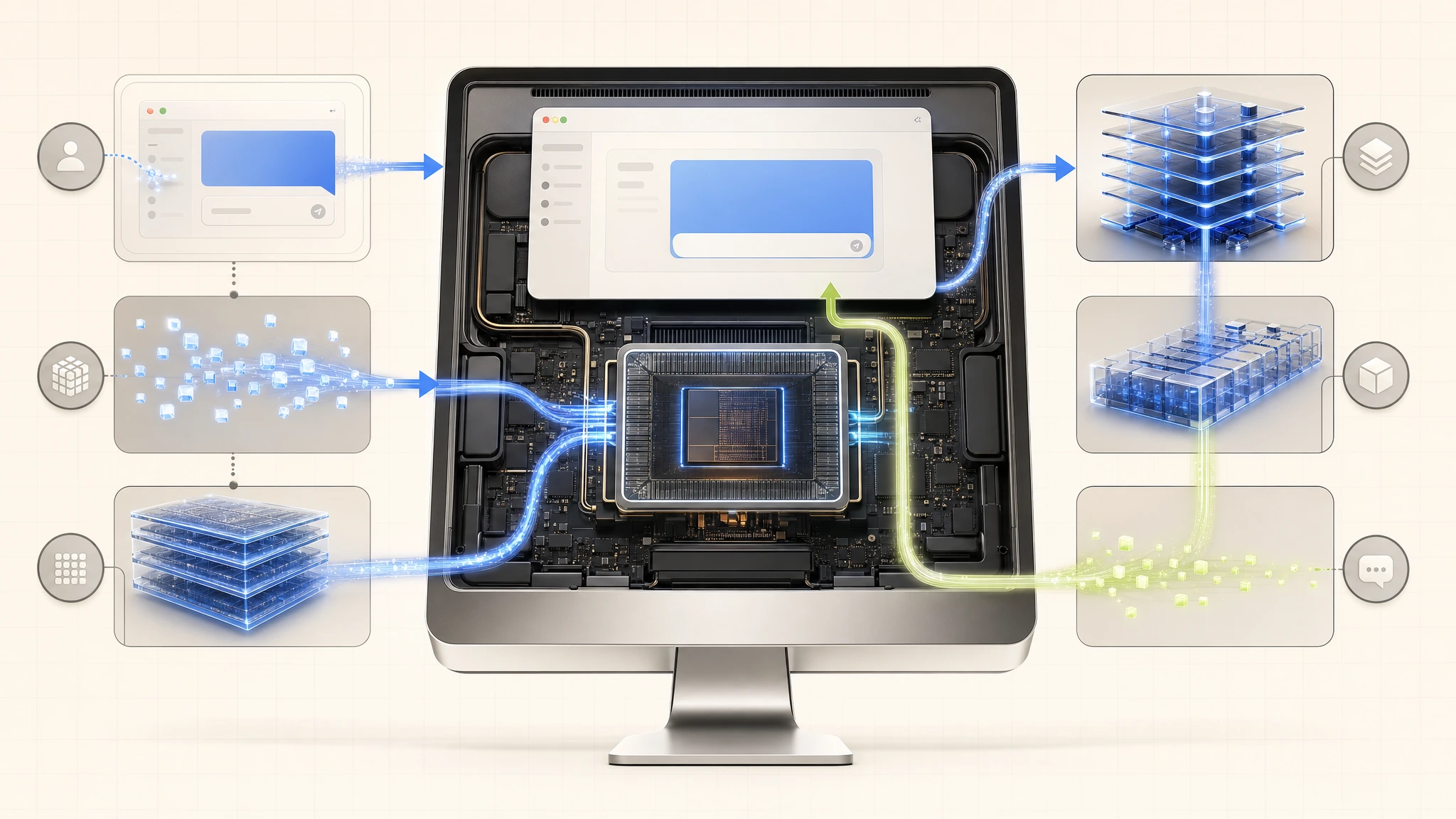
Model capability boundaries
Apple Silicon unified memory
MLX arrays use the Mac's shared CPU/GPU memory system.
Unified memory reduces explicit transfers between CPU orchestration and integrated-GPU compute, but model weights, activations, and KV cache still consume finite physical memory.
Verified
Bounded model pool
Budgets, LRU eviction, pinning, cold swap, idle TTL, and probes bound multi-model use.
The pool shipped in v0.5.0 and was hardened in v0.5.3. It is not a unified adaptive controller.
Verified
Supported LoRA adapters
The native engine can apply supported LoRA adapters.
Adapter compatibility depends on the base architecture and weights; universal LoRA compatibility is not claimed.
Verified
Fourteen detected VLM families
The model library detects 14 vision-language model_type families.
This is an evidence-backed family count, not a guarantee that every checkpoint or processor variant will load.
Verified
DeepSeek V3.2 Swift overlay
v0.5.3 includes pure-Swift component parity for the DeepSeek V3.2 architecture.
A real-checkpoint smoke test remains pending and FP8 dequantization is absent, so this is not an end-to-end or universal MoE claim.
Verified
Speculative decoding
v0.6.0 ships the classic draft-model path through both the API and GUI.
Acceptance telemetry reports draft efficiency. Targets with non-trimmable hybrid or linear-attention caches are detected and fall back to standard decoding.
Verified
Hugging Face cache discovery
v0.6.0 can discover models in configured Hugging Face cache roots without downloading duplicate weights.
Discovery confirms a local candidate, not a universal load guarantee; architecture, tokenizer, processor, and checkpoint compatibility still apply.
Verified
Per-model chat-template overrides
v0.6.2 resolves templates in user file, built-in model_type, then checkpoint order.
Built-in overrides carry standard-path parity evidence, but template support is not universal; checkpoint-specific branches and unsupported swift-jinja syntax can still define the boundary.
Verified
Track G tested models
v0.6.2 adds four checkpoint-tested native model families.
Measured real-checkpoint generation: Seed-OSS-36B 4-bit at 18.2 tok/s; Hunyuan V1 Dense 1.8B 4-bit at 80.3 tok/s; Cohere Command R7B 7B 4-bit at 21.7 tok/s; and MiniCPM3-4B 4-bit at 18.7 tok/s. Results are checkpoint-specific, not family-wide performance guarantees.
Verified
InternLM3 theoretical support
v0.6.2 ships parity-verified InternLM3 code at the theoretical support tier.
Real generation has not been demonstrated. Public checkpoints ship tokenizer.model but no tokenizer.json, while the Swift tokenizer stack requires tokenizer.json; support remains theoretical until that load-path boundary changes.
Verified
OCR model recognition
Dedicated OCR checkpoints receive an OCR badge distinct from the generic Vision badge, and GLM-OCR is verified end-to-end.
GLM-OCR loads through the stock VLM path with no new model code and reads image text back. The badge is intentionally narrow: it appears only on a model that actually loads, so an OCR family that is detected but not yet ported, such as dots_ocr or deepseek-ocr, earns no badge. This is model recognition, not a universal OCR-quality claim.
Verified
Benchmark bottleneck attribution
A benchmark run samples the silicon while generating and attaches what limited its decode steady state to the saved result.
The attribution names the decode limiter, whether memory, thermal, bandwidth, or compute, with a confidence and the representative hardware behind it. A run too short to attribute is reported as unavailable instead of inventing a verdict, and low-confidence or estimate-based calls are flagged; it describes one measured run, not a family-wide benchmark guarantee.
Verified
Temperature and top-p
Temperature and nucleus top-p sampling are released controls.
These are the current exposed core sampling controls.
Verified
Expanded sampling controls
top-k, min-p, presence, frequency, and repetition penalties, plus per-request seed are planned.
DeepSeek expert-routing top-k is an internal architecture operation and is unrelated to user sampling top-k.
Verified
Official sources
- Apple Silicon unified memory
- Speculative decoding
- Temperature and top-p
- Benchmark bottleneck attribution
- Bounded model pool
- Track G tested models
- DeepSeek V3.2 Swift overlay
- Speculative decoding
- Per-model chat-template overrides
- OCR model recognition
- InternLM3 theoretical support
- OCR model recognition
- Benchmark bottleneck attribution
- Benchmark bottleneck attribution
- Temperature and top-p
- Expanded sampling controls
- Expanded sampling controls